


 Universtiy of Virginia Launches a Mathematics Pilot with Grasple
From an empty course to automatically-graded homework in just a few weeks.

“The OER course exercises TU Delft shared with us via Grasple were excellent - a ready-to-use linear algebra library that fit our course out of the box. And in the limited times where we needed to create more, I found building exercises using Grasple to be much easier than building exercises using other platforms. I even fed Grasple's AI our rough course notes and it turned the exercises into Grasple problems instantly. ”
— General Faculty Associate Professor Daniel James, University of Virginia
For many instructors, launching a new homework platform sounds like a semester-long project. At the University of Virginia (UVA), the experience looked very different.
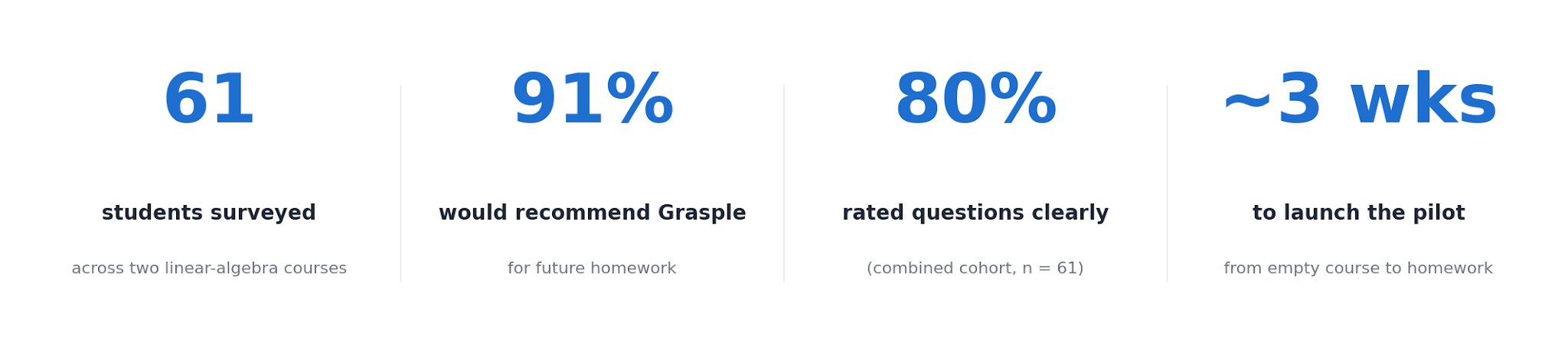
Within roughly three weeks, instructors went from an empty course environment to a working sequence of automatically graded homework sets that students could start using immediately. Within the same semester, the pilot expanded beyond a single class and reached almost two hundred students across multiple mathematics courses.
The Challenge
Assistant Professor Bakhyt Aitzhanova and Associate Professor Daniel James were preparing to teach introductory linear algebra at the University of Virginia. The two courses took quite different shapes.
Bakhyt's course was a more traditional linear algebra course, combining computational techniques with theoretical reasoning. Written assignments focused on proofs and conceptual understanding, while computational exercises required frequent practice and structured feedback.
Daniel's course was an applications- and computation-based linear algebra course, serving students in a wide variety of fields, including chemistry, data science, economics, and statistics.
In both cases, manually grading a large number of computational exercises would take a considerable amount of time. At the same time, these exercises are where students benefit most from immediate feedback while practicing.
The instructors needed a system that could handle automatically graded mathematics problems while still fitting naturally into a university mathematics course.
The key question was whether such a pilot could be launched quickly enough to support the semester that was about to begin.
Starting with a Mature Library of Exercises
Instead of building a course from scratch, the Grasple team recommended starting from the existing exercise library.
Grasple contains a large collection of openly licensed mathematics exercises that instructors can freely use and adapt. Because the content is part of an Open Educational Resources (OER) ecosystem, instructors can reuse, modify, and reorganize material to match their own course structure.
For the University of Virginia pilot, this approach made the setup process remarkably efficient. Both instructors built their courses almost entirely from pre-made assignments already available in the platform by selecting exercises that aligned with their course topics. Where additional structure was needed, the Grasple team helped assemble the exercises into homework sets.
What made this library particularly valuable is its origin.
Many exercises have been developed and refined over several years of teaching experience at leading universities, such as TU Delft. Because of this, UVA instructors were not starting from scratch. They were starting from exercises that had already been used and improved in real courses.
This maturity in the content library made it possible to build the first homework sets very quickly. Within roughly two to three weeks, the course moved from an empty environment to a functioning set of assignments ready for students.
Feedback Designed for Learning
One of the most important aspects of Grasple exercises is the feedback students receive while working. Every exercise includes carefully designed feedback that guides students through the learning process.
Instead of simply telling students whether an answer is correct or incorrect, the system provides explanations that help students understand what went wrong and how to approach the problem. This feedback often includes step by step reasoning, conceptual hints, and explanations of common mistakes.
For students learning topics such as matrix operations or solving systems of equations, this kind of feedback is essential. It allows them to learn while practicing rather than waiting until graded homework is returned.
From the instructors' perspective, this changes the role of homework. Instead of serving only as an assessment tool, the exercises become part of the learning process itself. Students can attempt problems, reflect on the feedback, and try again until they understand the concept.
This was an important element of the UVA pilot. The automatically graded exercises provided students with continuous feedback, while written assignments could focus on proofs and deeper conceptual reasoning.
Teaching with Parameterised Exercises
Another key capability used in the pilot is parameterisation. Grasple exercises are designed so that each student receives the same conceptual problem but with different numerical values.
For example, a problem about solving a system of linear equations may generate a different matrix or vector for each student or each attempt. Students practice the same method, but copying answers becomes ineffective. This approach allows instructors to assign meaningful practice while maintaining academic integrity.
Assignments in the UVA courses were created as structured self tests with defined opening and closing times. Instructors could also limit the number of attempts for graded homework. Students received frequent computational practice with immediate feedback, while written assignments focused on mathematical reasoning and proofs.
Publishing Content as the Course Evolves
Another feature that proved extremely valuable during the launch was the ability to release course material gradually.
In many mathematics courses, instructors prefer not to finalize every homework assignment before the semester begins. Teaching evolves based on classroom discussion and student progress. Grasple allows instructors to publish assignments incrementally. Homework sets can be prepared in advance but released only when needed. Future topics can remain hidden until the course reaches them.
Assignments for the first weeks were ready, while later homework sets could still be adjusted as the semester progressed.
How Students Experienced the Pilot
At the end of the semester, students from both courses were surveyed about their experience with the platform. Sixty-one responses came back across the two cohorts. The pattern was consistent: a clear majority rated the questions, the clarity, and the overall experience positively.
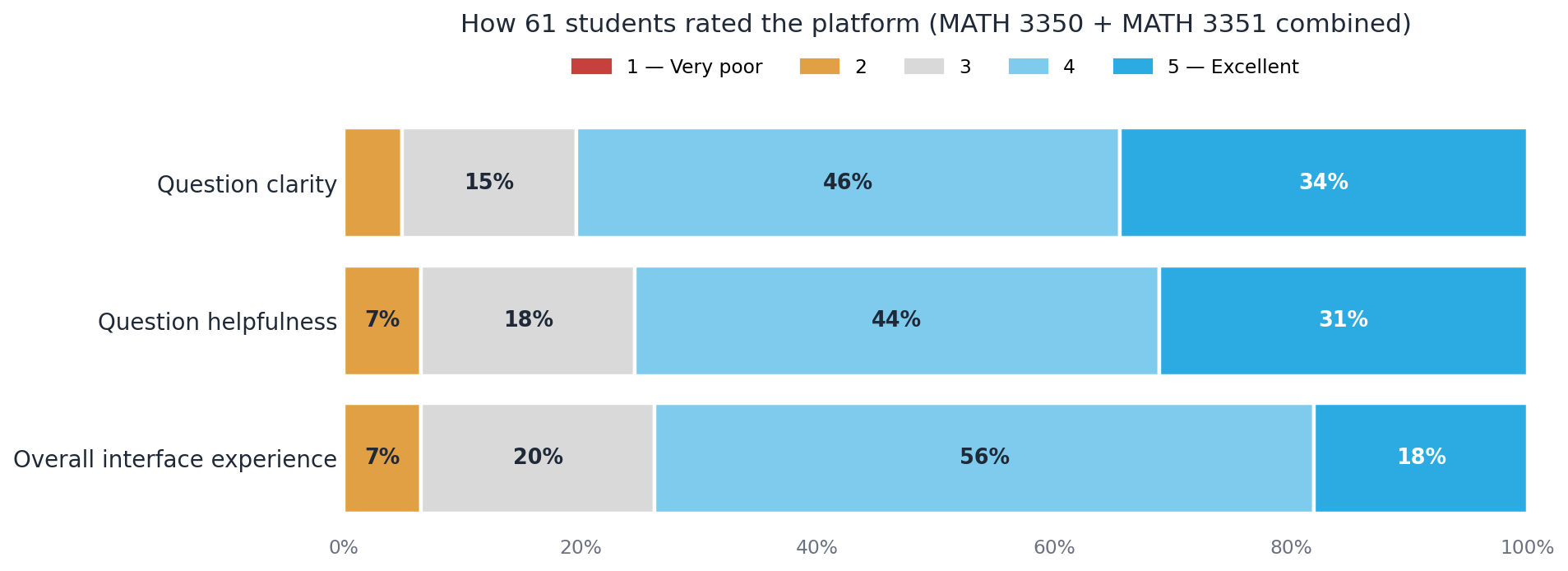
How 61 students rated the platform across both courses combined.
Eighty percent of students gave the clarity of the questions a rating of 4 or 5 out of 5. Question helpfulness landed close behind, with 75% rating positively. The overall interface experience was rated 4 or 5 by 74% of students.
The signal on whether students would want to keep using Grasple was even stronger.
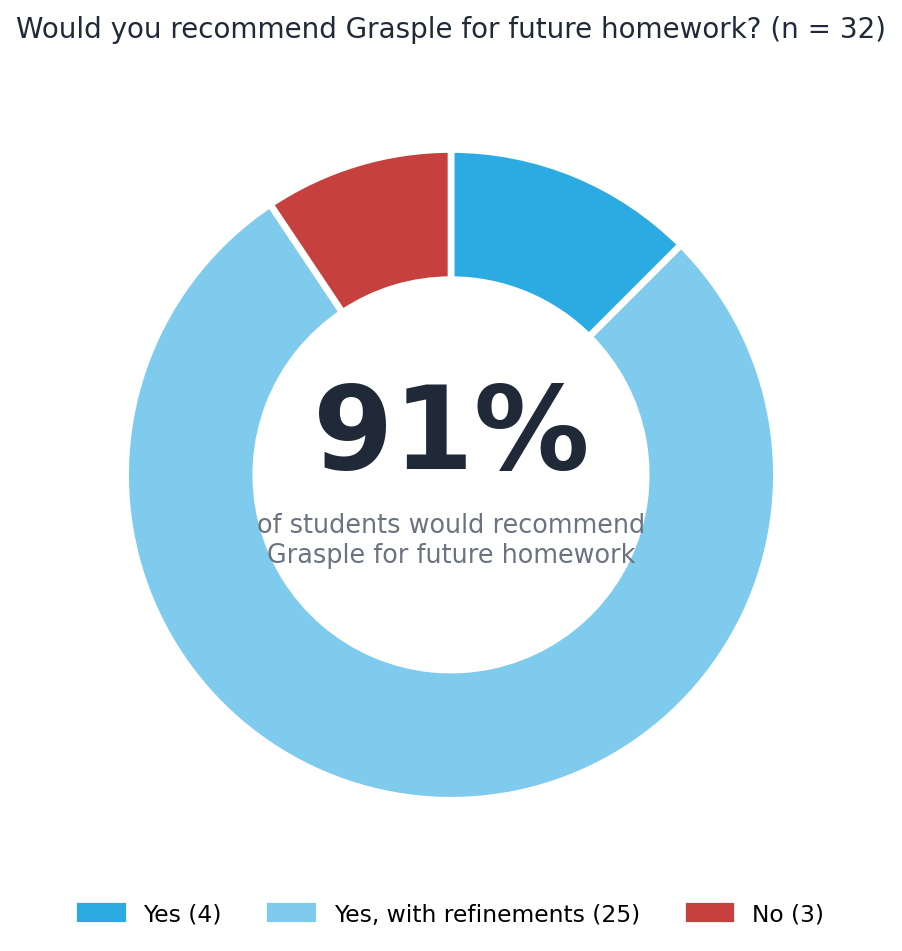
This kind of pilot is exactly where that nuance matters: students endorse the approach while pointing to the places where it can still be polished. The Grasple team is using this feedback as direct input for the next iteration.

“What I loved most about using Grasple as an instructor is how much time it saved both me and my grader by automating the grading of routine calculations, such as elementary row reductions and matrix multiplications. This freed up valuable time and space in the course for students to focus on developing their proof skills and deepening their conceptual understanding of the material. Just as importantly, Grasple provided timely feedback, so students could correct misconceptions before we moved on to new topics that built on earlier ideas.”
— General Faculty Assistant Professor Bakhyt Aitzhanova, University of Virginia
A Pilot with Room to Grow
The initial deployment at the University of Virginia already supports almost two hundred students across multiple mathematics courses.
The instructors have begun discussing potential next steps such as faculty demonstrations, outreach to colleagues, and additional use cases for the platform. One example is using Grasple for mathematically rich pre-class assignments in flipped classroom models.
For instructors considering their own pilot, the lesson from the UVA experience is clear.
A platform built on open educational resources, supported by years of teaching experience from institutions such as TU Delft, can make the transition to automated homework surprisingly smooth.
Instead of spending months building content, instructors can start with high quality exercises that already include structured feedback and thoughtful pedagogical design.
That foundation made it possible for the University of Virginia to move from an empty course to a working homework system in just a few weeks.