Mathematical Depth in Grasple
From first-year calculus to advanced engineering mathematics
.gif?width=1280&height=832&name=Grasple%20-%20diagonalize%20-%20diagonalizable%203x3%20matrix%20-%203%20differenet%20eigenvalues%20(2).gif)
Grasple is best known for supporting university mathematics and statistics courses, but its mathematical engine is not limited to any particular level.
Grasple’s mathematical capabilities support a wide range of university programmes, from research methods to quantum mechanics.
Our platform offers dedicated Mathematical and Physics answer check methods to support learning at all levels. Grasple's interpreter operates on mathematics, symbolic expressions, vectors, matrices, and solution spaces. It supports this breadth by design.
Beyond simply validating a student's final answer, these mathematical check methods also make it possible to recognise common mistakes, enabling targeted, mathematically-grounded feedback that is tailored to each student's approach.
Teachers stay in control
We know that, even though an answer is algebraically equivalent, that doesn't mean it achieves the learning goal. That's why we give you a wide variety of check types and conditions, so you can configure your exercises to match the level of precision required in your subject and at your students' level.
Grasple reads math as math, not text
Grasple recognises algebraically equivalent expressions and considers them equal by default.
.gif?width=1920&height=1080&name=Grasple%20Levels%20-%20Advanced%20math%20+%20Answer%20rules%20(3).gif)
Advanced STEM questions
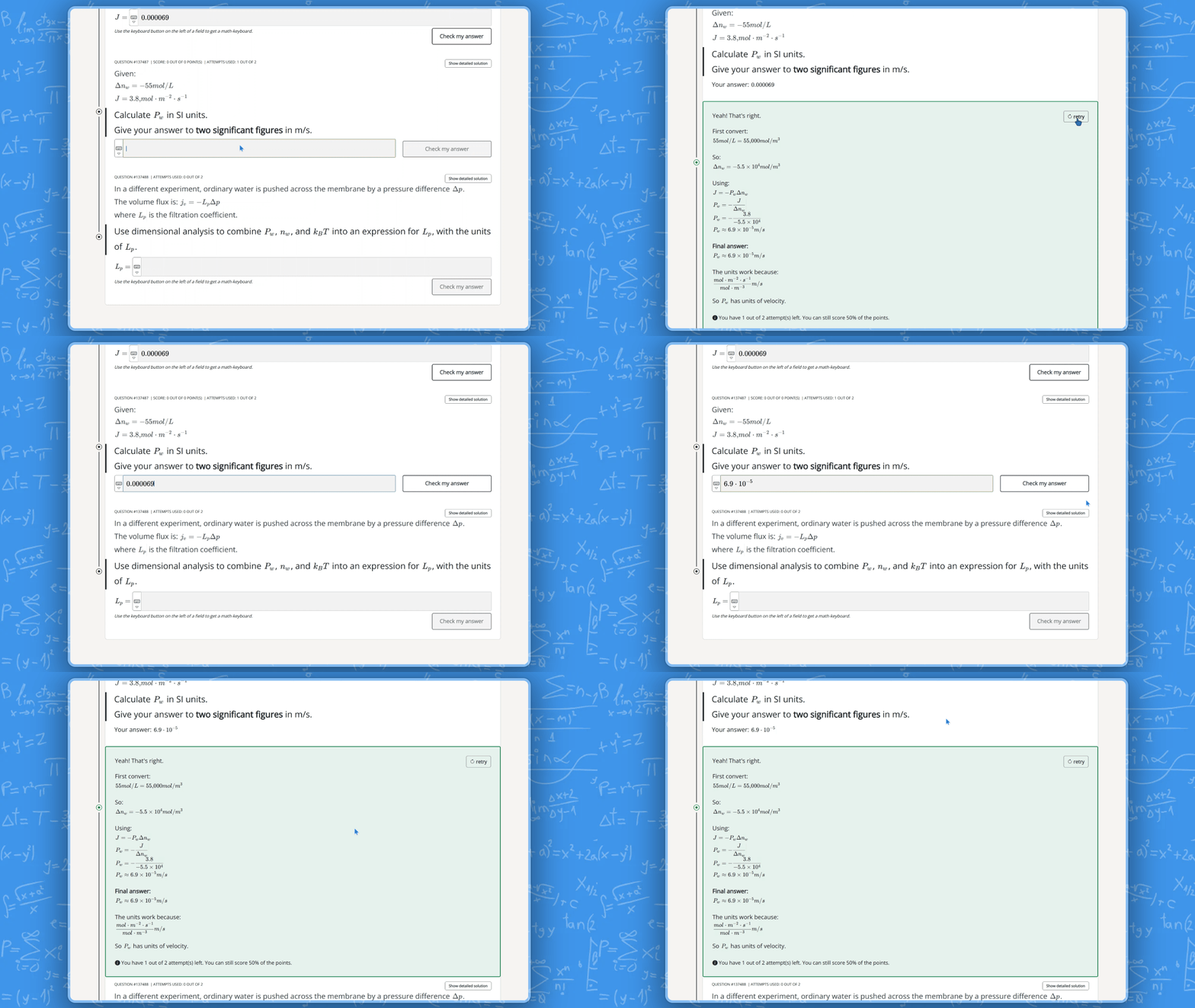
Unit type questions are perfect for advanced physics, engineering, and more. Decide whether equivalent units are accepted or demand precision in the question's notation.
Create unique answer rules
Tell Grasple's CAS what to do with specific student answers, giving you control over which answers and which forms are accepted. Plus, you can give specific feedback to your students to correct common errors.
.gif?width=1280&height=720&name=Units%20+%20Equivalencies%20(1).gif)
Mathematical capabilities
At the core of Grasple is a mathematical interpreter that evaluates student input as mathematics, not as text. Answers are checked for mathematical meaning, so students can enter any correct form of an answer, and instructors can decide exactly how strict the comparison should be.
Grasple currently supports the following answer-check methods:
Comparison and numerical checks
Defined, greater/less than (or equal to), and numerical evaluation to a (complex) number.
Same ordered collection
Compares ordered lists of numbers, formulas, vectors, or matrices element by element.
Same exact form
Requires mathematical equality and the same written form, useful when the notation itself is the learning goal (e.g. a fully simplified expression).
Algebraic equivalence
Default checks whether two expressions are indeed mathematically equal (e.g. x + x ≡ 2x). Works for exact numbers (including constants such as π), formulas, vectors, matrices, and unordered collections.
Specialised linear algebra checks
Parallel vector, same basis, same orthogonal basis, same orthonormal basis, same solution to a system of equations (including solutions with free variables), and is-diagonal-matrix. These allow grading of answers that are correct but not unique, a basis, for instance, can be written in infinitely many valid ways.
New checks
Because checks operate on genuine mathematical objects, symbolic expressions, complex numbers, vectors, matrices, sets and solution spaces, instructors can build exercises with targeted, answer-specific feedback at any level of mathematics. The set of check methods is actively being expanded, and new methods can be added based on partner and customer needs.
Become a pro
Creating interactive high level mathematical exercises and questions based on your math skills