



For Grasple this is not a new concept. It has always been one of its designing principles
The teacher as guide: What this actually means
Shifting from gatekeeper to guide is not about stepping back. It is about stepping up into a more demanding and more important role.
A guide does not just provide answers. A guide designs the journey: sequencing challenges appropriately, knowing when to go further, recognising when they are stuck and why. A guide sets the standard: defining what genuine understanding looks like, and insisting on it, even when shortcuts are available. A guide builds the relationship: understanding together with the student their progress, identity, and development as a professional, not just as an answer-producer.
Assessment should be a conversation between educator and learner, embedded in a broader journey of development. This is not a new idea. But AI makes it both more achievable and more necessary.
The learning cycle is a journey
At Grasple, we have always believed that meaningful learning happens in a cycle, not a straight line from lecture to exam. The cycle looks like this:
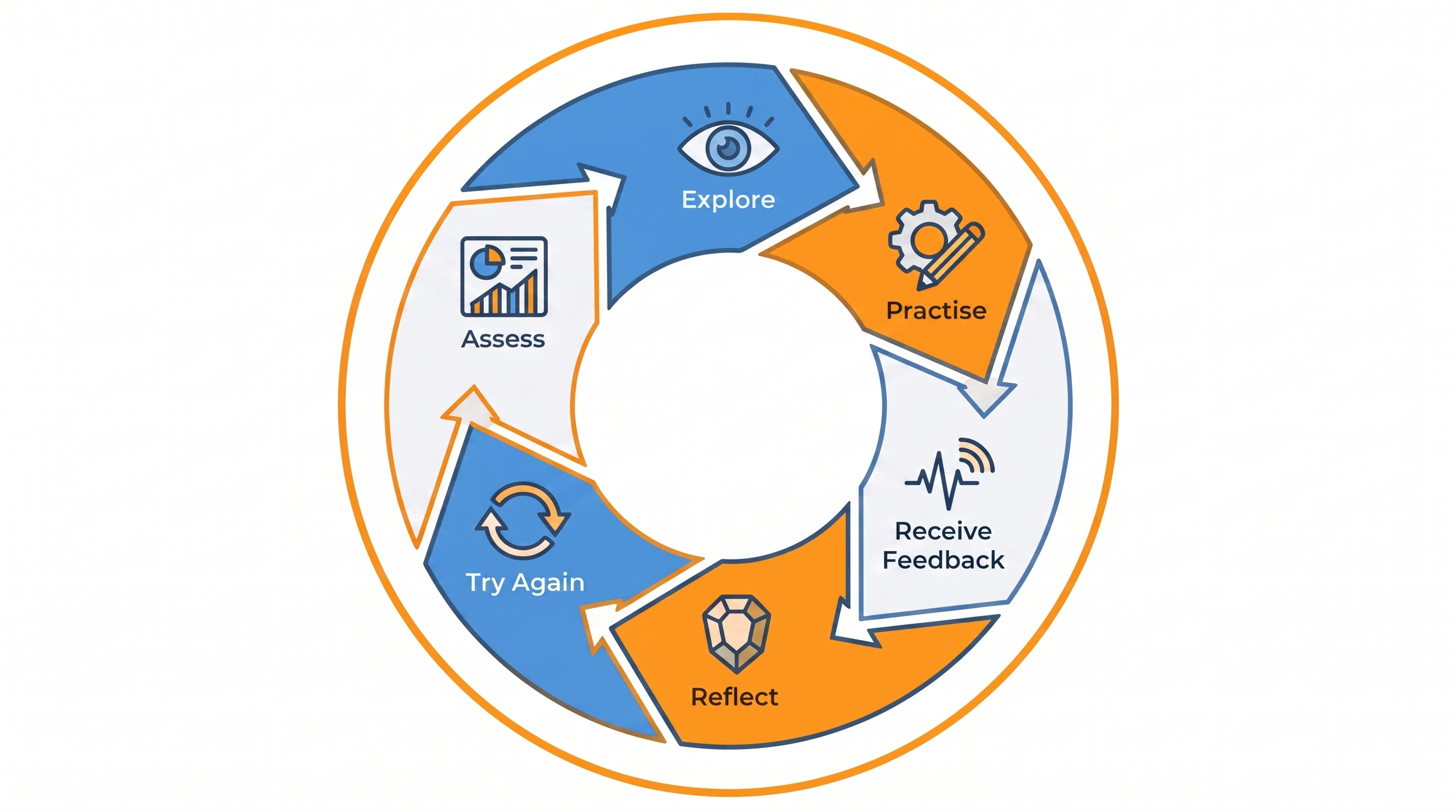
Explore→ Practise → Receive Feedback → Reflect → Try Again → Assess → Reflect Further
Every element of this cycle matters. Formative practice builds fluency and reveals gaps. Diagnostic assessment identifies where a student truly stands. Summative assessment confirms, fairly, transparently, and rigorously, what has been achieved. None of these are enemies of each other. They are parts of a coherent whole.
What breaks this cycle is when assessment is treated as a separate, high-stakes event that arrives at the end of learning, disconnected from everything that came before. That is when students cram. That is when anxiety peaks. That is when the exam becomes something to survive rather than something to demonstrate genuine understanding.
Grasple was built to support the full cycle. From adaptive practice and immediate, specific feedback to real-time analytics for educators and, yes, summative assessment with the rigour and security that institutions require. The summative exam is not an afterthought. It is part of the journey, not the end of it.
The teacher in control - even in an AI world
Here is where Grasple's position differs from many EdTech platforms rushing to integrate AI: we believe the teacher must remain in control. Not as a symbolic gesture, but as a design principle.
Grasple's AI vision is built on this foundation. As Elisabeth Schmoutziguer, Grasple's CEO, has written: "AI must work with educators and learners, not around them." Higher education institutions can remain a key guidance role in content, pedagogy, and data. AI should be an amplifier of teaching expertise, extending its reach without diluting its standards.
This means that when Grasple uses AI to generate or personalise content, every suggestion is traceable, verifiable, and editable by the educator. It means that learning materials created by teachers belong to teachers and can be shared across institutions through open, community-reviewed repositories. It means that a student using Grasple's is being guided towards deeper understanding, not handed a shortcut to the right answer.
This matters because the risk of AI in education is real. When AI simply gives students the answer, it short-circuits the very process, the struggle, the feedback, the reflection, that produces learning. An AI that replaces practice is not a learning tool. It is a learning obstacle.
Grasple's approach is different: AI should prompt curiosity, scaffold problem-solving, and guide the learner towards the insight, not deliver it pre-packaged.
The institution's role: architect of the learning ecosystem
If the teacher is a guide, what is the institution?
In the old model, the institution was the owner: of the curriculum, the content, the qualifications. In the emerging model, the institution becomes what Grasple's AI vision describes as the architect of the learning ecosystem designing the environment in which students and educators interact, setting the standards, ensuring quality and integrity, and making principled choices about which technologies to trust with their students' data and development.
This is a serious responsibility. Not every AI tool is built with education's values at its centre. Not every platform that claims to "personalise learning" actually serves the learner rather than the platform's own engagement metrics. Institutions need partners who are transparent about how their systems work, who protect student data, and who understand that education is not a consumer product.
Grasple is committed to being that kind of partner. GDPR-compliant, externally audited, open about its AI principles, and built on a foundation of institutional trust rather than user-acquisition growth hacking.
Assessment for learning, Not just of testing
One of the most important shifts in contemporary educational thinking is the move from seeing assessment purely as a measurement tool to seeing it as part of the learning process itself.
This does not mean abandoning rigorous, summative assessment. It means contextualising it. A summative exam is most meaningful when it comes at the end of a well-designed learning journey, when the student has had ample opportunity to practise, receive feedback, identify gaps, and grow. When that journey has been supported well, the exam is not a surprise or a threat. It is a fair opportunity to demonstrate what has genuinely been achieved.
Grasple supports this vision end-to-end. The same platform that delivers adaptive formative practice can be used to construct and administer secure summative exams, with question pools to prevent copying, parameterisation to ensure each student faces a unique version of a problem, real-time proctoring dashboards, automated grading with human oversight, and post-exam analytics that feed back into course improvement.
This is the full assessment cycle, not a collection of disconnected tools, but a coherent system in which every element reinforces the others.
What is next?
The conversation about AI in education is often framed as a threat: to academic integrity, to teachers' jobs, to the value of qualifications. These concerns are not trivial. But the more interesting and productive question is: what kind of education do we actually want to build?
We want education that develops genuine understanding, not just the ability to produce correct-looking outputs. We want an assessment that is fair, transparent, and meaningful, not a high-stakes guessing game. We want teachers who are empowered as professionals, not deskilled by technology. We want institutions that remain trusted, relevant, and academically rigorous.
Grasple exists to help build that. Not by having all the answers, but by asking the right questions, alongside the educators and learners.
That, after all, is what a good guide does.
Curious about how Grasple supports the full learning and assessment cycle at your institution? Get in touch or book a live demo.