


The 20-Minute Rule and 3 Other Ways to Activate Statistics Students: Nelly Litvak's Tactics
From Watching to Doing: Active Learning in Statistics, Step by Step with Grasple
Based on the Grasple Statistics Community Session held on 8 October 2026 and Nelly Litvak’s presentation.

by Elisabeth Schmoutziguer
CEO Grasple
Students learn statistics by doing it, not by watching you do it. That was the core message from Nelly Litvak, Professor at the Department of Mathematics and Computer Science at Eindhoven University of Technology, at our Statistics Community session on 8 October.
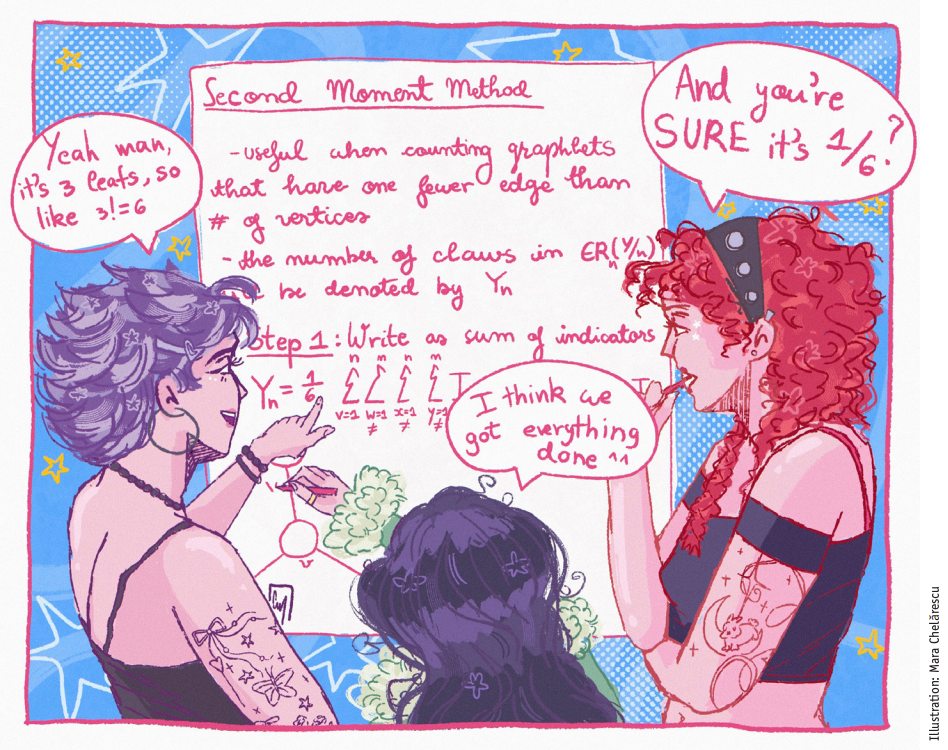
Problem solving: working on a whiteboard in groups of three. Illustration by Mara Chelărescu, originally published in Nelly Litvak’s article “The dream course”. Reproduced with permission.
Her timing argument is simple. Anything students do outside class can now be outsourced to AI. The time they spend in the room with you is an opportunity to make sure the thinking is theirs. So that time should go to students working, not listening.
Nelly shared four tactics that work in her own courses. Below, each one comes with clear steps you can try in your next lecture, plus where Grasple can take some of the work off your plate.
1. Turn your exercise session into a Thinking Classroom
Have students work on a problem in random groups of three, standing at a whiteboard and sharing one marker. That is the whole setup, and Nelly says it works like a charm. It comes from Peter Liljedahl's book Building Thinking Classrooms.
Why these details matter:
- Random groups reset expectations. Nobody arrives thinking, "She's the smart one, I'll just copy."
- Groups of three provide enough flow of ideas, but little room to slack.
- Vertical, erasable surfaces make it safe to try something, wipe it and try again. They also allow teachers to see what students are doing, making it easier to follow their thinking and offer support when needed.
How to try it next week
- Prepare the room. Bring a pack of static whiteboard sheets (they cling to walls or windows), one marker per group and a box of tissues as erasers.
- Make number cards. One card per student, face down. Students draw a card at the door; the number is their group.
- Pose one rich problem. Explain it briefly on the board. Give everyone one or two minutes to think alone first.
- Let groups work. One marker per group, passed around. Walk the room and listen.
- Manage the speed gap. Keep a red and a green marker on your desk. Stuck groups draw something red on the board; finished groups draw something green. Then send green groups to help red ones.
Nelly is candid that step 5 is the hardest part. Groups rarely finish at the same time, so plan a harder follow-up question for fast groups.
Where Grasple helps
- Find the problem. Browse the open statistics exercises for a good starter problem instead of writing one from scratch.
- Check every student afterwards. Close the session with a short Grasple quiz on the same topic. Group work can hide individual understanding; a quick individual check helps you see who really got it. Use the results to choose the problems for your next work session.
- Keep the follow-ups ready. Put easy, medium and hard follow-up exercises in one Grasple set, so fast groups always have a next step.
Tip from Nelly: if attendance is a worry, ask students to sign up and commit, rather than giving bonus points for showing up.
2. Pause your lecture every 20 minutes
Students can typically absorb new material for about 20 minutes before their working memory becomes overloaded. If new information keeps coming without time to process it, earlier concepts become harder to retain. This explains why students often say: “The beginning was clear, but towards the end, I struggled to keep up.”
The fix is a short moment of retrieval practice. Students recall and use what they just heard, helping them process the material before the next block. Nelly explains the science in How Students Learn.
A well-known technique for this is Think-Pair-Share: students first think about a question individually, then discuss it with a neighbour, and finally share and discuss their answers with the class. You can do this with a simple classroom discussion or use an online quiz to collect answers and make students’ thinking visible.
How to try it next week
- Cut your lecture into blocks of about 20 minutes. Mark a pause point in your slides after each block.
- Write one or two questions per pause. Aim them at a common mistake, not at exam level. Make them easy but a little provocative.
- Think and pair. Give students a minute to think alone, then a minute to compare their reasoning with a neighbour.
- Share and discuss. Invite students to share their answers, or use an online quiz to collect and display the results. Explain the answer yourself. Nelly finds students value this most: they want to hear the correct reasoning from you.
- Continue with the next block.
A good pause question for statistics: "Which of these four statements about the sample mean are correct?", with more than one correct option. Students must judge every statement, not just spot one answer.
Where Grasple helps
- Use a Grasple quiz in class. Share it with a simple link, so students can start straight away without creating an account. See Instant STEM Quizzes.
- Go beyond multiple choice. Let students enter formulas and numbers, and offer adaptive follow-up exercises for further practice or lecture preparation.
- Get real-time insights from the Learning Analytics. You see the percentage correct per question, so you know at once whether to move on or explain again.
- Reuse next year. Build up a set of pause questions once and use them every time you teach the course.
3. Alternative Grading: rough marks, many attempts
Many statistics students are grade-driven, especially non-majors who see the course as a box to tick.
Nelly's answer is alternative grading (read her article Competency-based grading), inspired by the book and Substack Grading for Growth. It rests on four pillars:
- Students know exactly what is expected of them.
- Students get feedback throughout the course, not only after the exam.
- Marks are rough: Excellent, Sufficient or Needs Improvement, for example, instead of a score out of 10.
- Revisions without penalty. Students get several attempts, with feedback after each one. Earlier mistakes do not count against them.
That last pillar matters most. Feedback after a final exam may explain why a student failed. Feedback in week 3 is something they can still act on.
How to try it in one course
Nelly's elective has three modules. Each module gets three chances to show mastery:
|
Moment |
Modules tested |
|
Week 3 |
Module 1 |
|
End of module 2 |
Modules 1 and 2 |
|
End of module 3 |
Modules 2 and 3 |
|
Final exam |
Modules 1, 2 and 3 |
- Define the marks. For example, Sufficient means a solid, confident 60%, not a pile of partial points. Excellent means no fundamental errors, roughly 90%. Needs Improvement means exactly what it says and roughly corresponds to a score below 60%. Three marks are usually convenient, but you can use more and name them differently.
- Map marks to a final grade. For example: three times Sufficient gives a 6; three times Excellent gives a 10.
- Tell students it is not a failure to get Needs Improvement. It is feedback with a next chance attached.
- Keep the grading load manageable. Test computation and understanding of definitions digitally. Keep only one or two written questions for mathematical arguments.
Where Grasple helps
- Set up formative tests per module. In the test settings you choose opening and closing times and the maximum number of attempts.
- Give a fresh test every attempt. Use question pools or random selection, so a retry is not a copy of the first try.
- Turn on feedback after submission. Let students review which answers were correct and see your question feedback, so each attempt teaches them something.
- Ask deeper digital questions. Conditional-logic and/or multiple-answer questions and formula input can test real understanding, and Grasple grades them for you.
- Discuss the written part. When students come in for support, you can use their handwritten notes to guide your instruction.
- Spot where the class struggles. See how each test question was answered and adjust your next lecture. Compare attempt 1 with attempt 2 to see whether your feedback worked.
4. Never underestimate human connection
Nelly calls this the holy grail of education. Learning is a social process, and a few minutes spent getting to know your students pays off all course long. Her favourite opener takes about ten minutes.
How to try it in your first lecture
- Ask: "What are you good at?" Everyone writes something down on a piece of paper.
- Hear a few answers. In a small group, let everyone share. In a big hall, ask one row to share and collect the rest of the papers.
- Ask the follow-up: "How did you become good at it?" The answers will be practice, practice, practice.
- Make the link to your course. Statistics works the same way. That is why the practice sessions matter.
- Read the papers afterwards. Gymnastics coach, violinist, debating team: you will see your students differently.
Nelly was surprised by the side effect. Knowing her students as talented individuals changed how she walked into the room, and her contact with them became more personal.
Two more habits she recommends:
- Name first, then content. When a student asks a question, ask their name before you answer.
- Agree on class rules together. Ask students what respectful and responsible behaviour looks like in your class, and type their answers live on a slide. Show the same slide later. Students follow rules they helped write, such as "think alone for a minute before discussing."
Fun fact: After discovering all the hidden talent in her classroom, Nelly teamed up with colleagues and organised a student-teacher concert! A lovely example of how getting to know your students can lead to unexpected opportunities.
Connect it all with learning analytics
Each tactic above gives you a moment where students engage with their learning. By using Grasple to support these moments, you can also collect valuable insights into their progress. Put together, these insights show you how your class is doing week by week, not only at the exam.
Nelly made the same point about Racing Lab: play the same topic several times during the course, and you and your students can both see whether the class is improving. The same idea works for Grasple activities.
Four moments, one picture
|
Moment |
What students do |
What the data tells you |
What you do next |
|
Quiz in the lecture |
Answer 1 or 2 pause questions every 20 minutes |
Percentage correct per question, live |
Explain again or move on, right away |
|
Work session |
Solve problems in groups, then a short individual Grasple check |
Which students understood, not only which groups finished |
Pick the problems for the next session |
|
Formative test at home or in class |
Take a module test, with several attempts and feedback |
Results per question and per student, attempt after attempt |
Plan a recap on the weakest questions; contact students who fall behind |
|
Individual practice |
Work through subjects at their own pace, with instant feedback |
Who practises, how much, and which topics cause many wrong answers |
Start the next class with the most common mistakes |
How to set it up in one course
- Build one Grasple course with a block per week. Add the practice subjects, the in-class quiz and the module test for that week.
- Set a practice deadline shortly before each class. Then check the main patterns in the results before you teach.
- Open each class with a five-minute recap of the mistakes you saw in the data. Students see that their practice matters.
- Use the same questions twice. Give a topic as a quiz right after you teach it, and again two weeks later. The difference helps you see whether students have retained what they learned.
- Check your progress overview once a week. See which topics generate many wrong answers and which students have stopped practising.
- Tell students which activities are graded. Keep practice clearly formative, so they feel safe to make mistakes.
Let students steer their own practice
A large course cannot give every student personal attention. Grasple helps students find their own way:
- Plenty of practice material. Students can draw on the large library of open statistics and probability exercises, across a range of topics and levels.
- Feedback after every answer. A wrong answer can come with an explanation, hints and a worked solution, so a mistake becomes a learning moment.
- A map of what to learn first. The knowledge graph shows how topics depend on each other. A student stuck on confidence intervals can see they should first refresh the standard error.
- Their own results as a guide. After a formative test, students see which questions they got wrong and why. That helps them identify which subjects to practise before the next attempt.
- A brush-up path for weak starters. Give a short diagnostic test at the start of the course and offer a warm-up module to students who score low.
This is where alternative grading and analytics meet. Students get a clear next step after every attempt, and you see who takes it.
For how-to guides, see the Help Center section Tracking the progress of your students and the Real-time Learning Insights feature.
Your quick-start checklist
You do not need to change everything at once. Pick one tactic and try it this week.
- Open your first lecture with "What are you good at?"
- Mark a pause point every 20 minutes and add one Grasple quiz question to each.
- Run one exercise session as a Thinking Classroom with random groups of three.
- Set up a formative Grasple test with multiple attempts and feedback turned on.
- Set a practice deadline before each class and open with a five-minute recap of the most common mistakes.
- Book a 15-minute Racing Lab round before the exam.
Tried one of these? Share how it went at the next Grasple Community meeting. Good and bad experiences are both welcome; that is how we learn from each other.
About Nelly Litvak
Nelly Litvak is a full professor at the Department of Mathematics and Computer Science at Eindhoven University of Technology (TU/e), where she works on algorithms for complex networks and random graphs.
She received her PhD from TU/e and EURANDOM in 2002 and spent many years at the University of Twente, where she was named Teacher of the Year in 2022. She teaches statistics and probability to large groups of engineering and computer science students, and she is the author of several best-selling popular books about mathematics.
Alongside her research, Nelly writes about what actually works in university mathematics teaching. Her column series Better than Blackboard appeared in Nieuw Archief voor Wiskunde, the magazine of the Royal Dutch Mathematical Society, from 2023 to 2026.
Read more from Nelly
- Better than Blackboard, her full series on university maths education, with all articles as free PDFs.
- We shouldn't give classroom lectures anymore, on why long lectures fail and what to do instead.
- How Students Learn, on the four things every student needs to learn.
- Competency-based grading, her introduction to alternative grading.
- Alternative grading in probability and statistics, her guest post on Grading for Growth about a course for 300 computer science students.
- ChatGPT: Great Promise for Teaching or Global Pedagogical Tragedy?, on AI in the classroom.
- Her profile at TU/e.
Nelly also publishes her statistics lectures for engineers on YouTube.
Books Nelly mentioned in her talk: Building Thinking Classrooms in Mathematics by Peter Liljedahl, Grading for Growth by Robert Talbert and David Clark, and Uncommon Sense Teaching by Barbara Oakley and colleagues.
Sources
- Nelly Litvak, It's Students' Time to Do the Work, Grasple Statistics Community session, 8 October 2026.
- Nelly Litvak's blog: Better than Blackboard.
- Grasple Instant STEM Quizzes.
- Grasple Help Center: Assessments in Grasple.
- Grasple Help Center: How do I change the settings of a test?.
- Erasmus University Rotterdam: Grasple in your education.
Image credits: Thinking Classroom illustration by Mara Chelărescu, reproduced with permission for this blog only. Racing Lab poster by PRIME, TU Delft, from the 8 October session slides.